
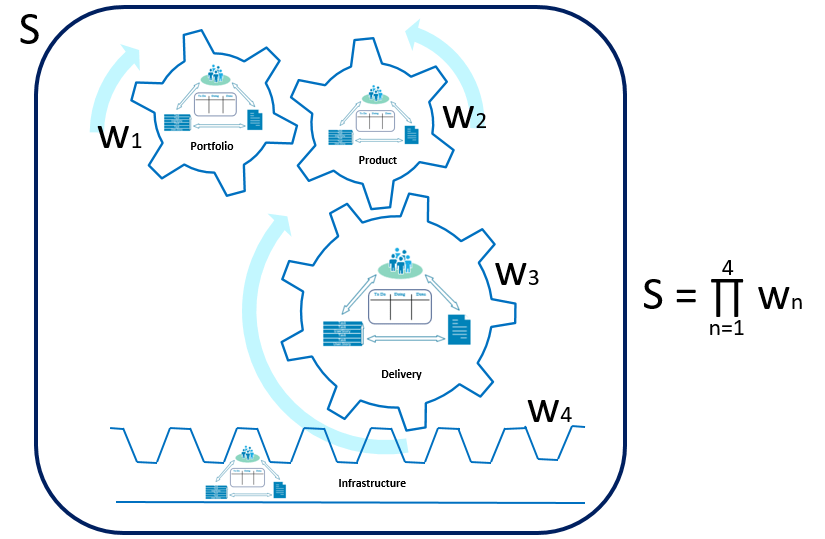
The Agile Operating System (AOS) is a global enterprise model, powered by continuous improvement approach to both the how and why things are done, and launched by a collection of alternative agile practices that drive the teams value delivery approach.
- The AOS takes a system thinking perspective: its parts (Portfolio, Product, Delivery, Infrastructure, and Release value workflows) are interconnected and their outputs interdependent. The behavior of these workflows is controlled by feedback loops implemented throughout the system. The constant value flow structure of the AOS determines the constant output behavior of the individual workflows.
- The AOS includes transformational learning: continuous improvement behavior is aimed not only at changing and improving the practices (the how things are done) but it also looks at the essence of the workflows (why things are done). The essence of the AOS needs to be challenged and improved accordingly.
- The AOS is based on probing practices: each practice is not the final solution, we may take imperfect action, then we inspect and adapt with purpose, the goal is learning and evolutionary change towards a more satisfactory solution. Alternative practices may find their way into the model according to the team’s needs and understanding of the value delivery chain.
The AOS takes a systems-thinking approach instead of merely being a collection of components and practices, underlying the lean nature of the model. It is based on agile principles and no single practice is a requirement on its own, while there’s an emphasis on continuous learning and adapting.
The AOS attends to the entire value stream making all work, workflow, capacity and dependencies fully visible throughout. It explicitly manages work in process, while there’s a focus on quality being built in.
Leadership & management are invited to create quality spaces within which people can work autonomously towards the goal of the organization. The model on which work is based, provides some predictability of the challenges to be encountered.
Note: This analysis is inspired by a post by Al Shaloway from NetObjectives in LikedIn

 Adaptive Ways