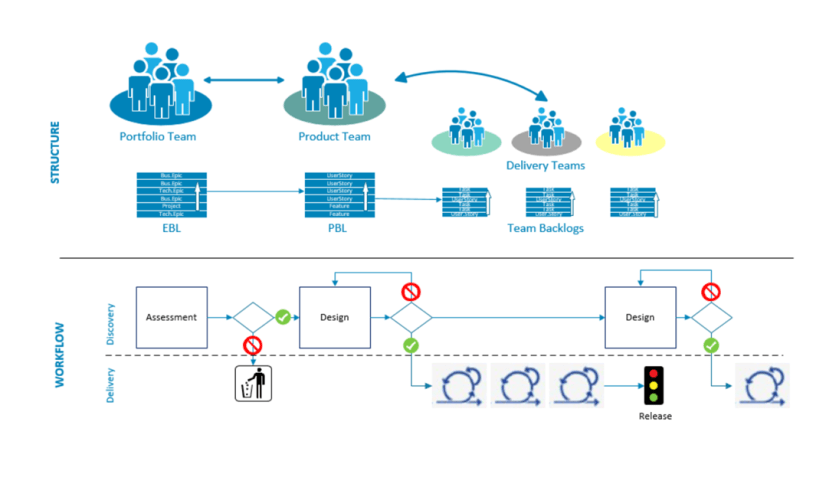
The Agile Operating System (AOS) promotes a model in which structure and workflow are the main components. The agile structure consists of teams and backlogs, brought together by work agreements. The agile workflow consists of discovery and delivery functions, where, respectively, decisions are taken to “do the right thing” that makes business sense for the organization, and where decisions are made in order to “do the right thing right” that delivers value and delights the Customer.
- The Portfolio team is due to make the best production decision possible (assessment and decision phase)
- The Product team is meant to define a coherent product strategy (design phase)
- The Delivery teams are to show real impact (execution and release phase)
At all levels teams need to consider uncertainty (risk evaluation), must engage all employees (clear communication, total transparency, understanding of company goals), and empower front line teams (decision making on doing the right thing right)
The discovery phase is where probing takes place and decisions are made as to pursue or bin business and production initiatives. The ones that get the green light will be designed for coherent value delivery and then probed for acceptance or re-work. the delivery phase is where aproved design gets to be worked on by delivery teams and to be released on cadence (continuous delivery).

 Adaptive Ways