

The Kanban Lens
In his blog Andy Charmichael defines the Kanban lens as follows:
- See work as flow
- See workflow as a sequence of knowledge discovery steps
- See knowledge work as a service
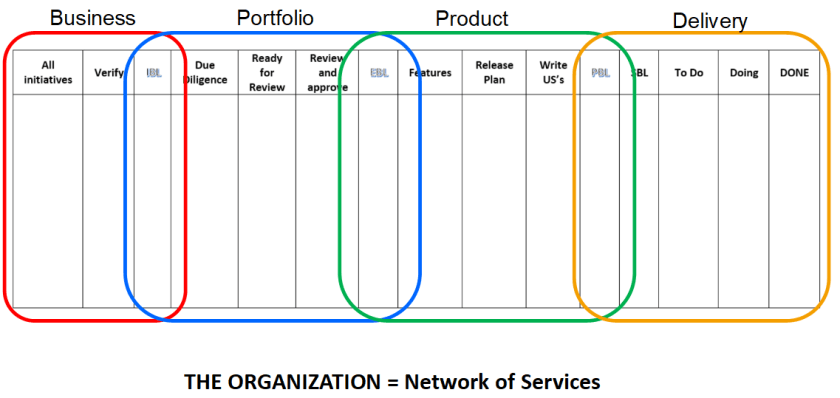
- See the Organisation as a network of services
The Agile Operating System (AOS) can be then analized through this lens as follows:
Work as Flow
The AOS value delivery chain (Portfolio, Product, and Delivery management) is a continuous flow, where the outcomes of one process is the input for the next, and where continuous value delivery and improvement are facilitated through feedback loops.
Discovery steps
From idea to cash, the AOS distills a business idea through its various phases, caring for the right thing done right at the right time. The discovery steps through the different knowledge areas – business, design, and technical governance – allow for early decision making and pivoting according to market and client needs. A right to left approach of the value stream allows for this.
Network of services
The different processes that compose the AOS are all interactive and render services among themselves by attending to the specific needs. This service approach is extrapolated by the the system to attend to the market and client needs.
Knowledge work as a service
The AOS is a continuum of knowledge work to deliver a service that the end client benefits from, the materialization of an idea through fit for purpose value delivery in a timely manner.

 Adaptive Ways