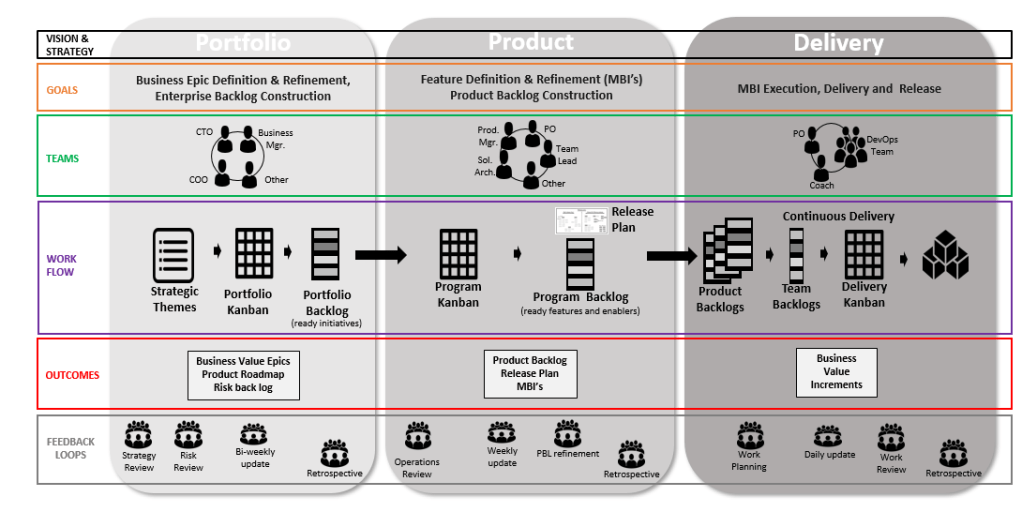
The Agile Operating System (AOS) addresses the value stream of an organization by identifying the relevant workflows that intervene in the business value creation process.
Business value creation is guided by the organization’s vision and strategy, providing a means for workflows to align by definitng goals and the results needed to acheive these.
It also recomnends the creation of teams, that posess all the necessary skills to execute the work items within the workflow and take full ownership of the delivery of desired outcomes.
The entire system is glued together through dualfeedback loops wich not only allow to inspect, learn and improve the way work is executed and delivered, but to clarify uncertainties and smoothen relationships among teams.
Hi, I’m Mario – retired agility warrior from a major Swiss bank, beyond agile explorer, lean thinker, former rugby player, and wishful golfer.
I’ve been in the agile space since 2008. I began consulting in 2012 with a Scrum adoption in a digital identity unit — and that path eventually led me to design an Agile Operating System at organisational scale.
What pushed me further was frustration: poor adoption, illusionary scaling, and “agile” that looks busy but doesn’t improve business outcomes.
That’s why I developed the Adaptive Fitness System (AFS) — an approach that treats agility as fitness for change: fit for purpose, fit for context, fit for execution, and fit for continuous improvement. Today, I use AFS to help organisations sense what’s real, learn fast, and adapt with intent.
View all posts by Mario Aiello


 Adaptive Ways