
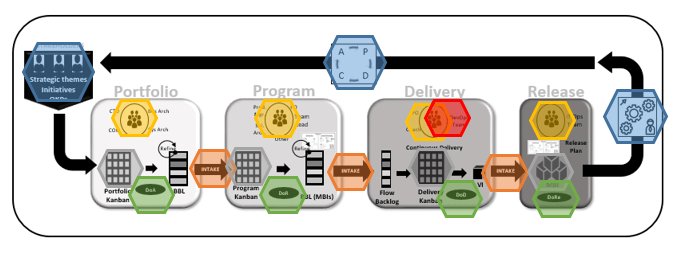
The Agile Operating System facilitates the scaling of an agile transformation by promoting suatainable business agility . Sustainable agility and meaningful change relies on an ecosystem that supports new ways of working that extend from the team level to the executive level.
Business agility (according to Al Shalloway, PMI agility thought leader) is about the quick realization of value in a predictable, sustainable, and high quality manner. It is facilitated by six main actions:
- the way work is accepted
- the visualization of all work and work flow
- the team structure that carries out the work
- how these teams agree to deliver work
- work being delivered in a continuous manner
- the management that facilitates the appropriate ecosystem
The AOS value stream is conceived to support business agility:
All work intakes (orange hexagons in picture above) are intended to handle the value inputs from the previous processes in order to facilitate the work of the incumbent process, making sure that work is explicit, valuable, prioritized and lined up with capacity.
All work is visualized either in a physical or electronic manner (grey hexagons i.p.a.) providing visibility to the specific work flow and its contribution to the value stream.
Team structures are defined (yellow hexagons i.p.a.) and formed in such a way to handle all work intake and eliminate as many dependencies as possible.
The teams within the value stream make sure that they produce value outcomes by agreeing the work model and etablishing a work charter to govern interactions (green hexagons i.p.a.)
Work is processed and value outcomes delivered in a continuous manner through a DevOps approach (red hexagon i.p.a.)
Finally, the the ecosystem that sustains business agility is facilitated by the structure, governance and strategy of management and work processing like initiatives management, setting OKR’s, tech support and PDCA iterations (blue hexagons i.p.a.).
The AOS guides the transformation at scale by identifying and evidencing the impediments that get in the way of the system. Getting rid of these obstacles means putting into place a trustworthy environment for business agility. Then, agility that is fit for purpose, fit for context, and fit for practice, will thrive accross the organization.

 Adaptive Ways