
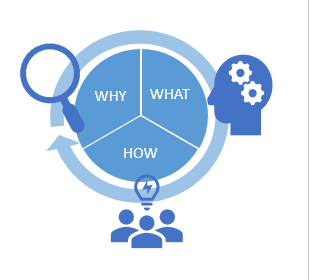
In general, when organizations turn to agile, they’ll pick a method and follow it to (hopefully) understand agile. This is somehow not appropriate as it ignores the fundamentals of why we are opting for agile as well as the operational context of the organization.
Understanding your context and the theory behind agile practices will help define, choose, or follow a method suitable for the organization’s context, that will serve the needs to achieve the defined goal.
For agile to make sense it needs to be fit for purpose (the goal and the needs), fit for context (the ecosystem we are in), and fit for practice (the theory behind methods and behaviors).
When agile is driven in accordance with wisdom and prudence it is likely to be beneficial to the organization. Therefore, understanding if agile will help drive the vision, understanding what the gaps between the current ways of working and the new proposed ones are, and understanding what the available agile methods propose, will pave the way for a successful agile adoption and the way to agility (team agility, enterprise agility, business agility)
From the moment we understand that agile can be promoted through behaviors and practices, no matter how constrained a team is, it may make the difference within an operations and delivery system. Behaviors and practices need to be sense making actions to become value add way of working.
Adopting behaviors such as, breaking work into smallest value items; working on one item at a time, most important first, and finishing it; seeking and providing help to other team members; delivering frequently requesting feedback; learning and improving from mistakes, will promote self-organization, transparency, focus on value delivery, and continuous learning. Further, it will foster a sense of priority, simplification, ownership, cooperation, communication, and improvement.
The same behaviors will require enabling practices such as story mapping, prioritization and sequencing, work intake, defining exit criteria, teamwork, dependency management, installation of feedback loops, shift left testing, probing and learning, and many other as needed.
Even if a team is operating in a non-favorable environment for agile, they can, through sense making behaviors and coherent practices, reach a certain level of “nimbleness” to embrace change and pivot accordingly increasing value delivery and learning.

 Adaptive Ways