
Usually in a business profit maximizing world, chasing (business) objectives is part of a plan: deliver more, faster, and cheaper, … please be more productive!
For this purpose, we chose an agile methodology that’ll help us towards our objective, and our focus is to adhere to the process to make things happen.
As we advance, we inspect for dysfunctionalities and blockers to the process, acting reactively for solutions and workarounds. We therefore deviate from the objective … this is clearly an antipattern!
A pattern
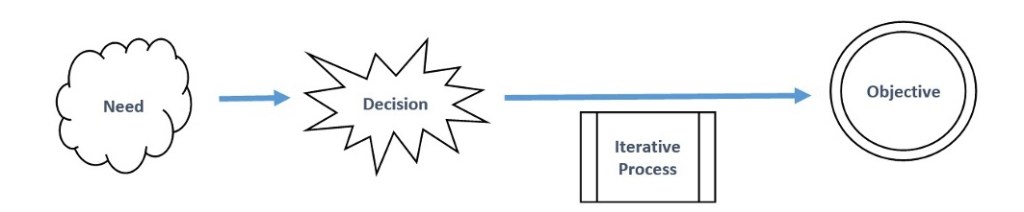
How about changing the paradigm, and the objective is triggered by a need: client delightment through business nimbleness. The satisfaction of this need is what motivates the decision to put together a set of actions to help us achieve the objective. Then we focus on achieving an outcome. We plan our way forward iteratively based on our present knowledge, monitoring our progress through relevant measures, and adapting to what we learn.
The case for agility
We need to change our ways of working to become more effective and efficient while adapting to our current reality in a predictable manner, to maximize quality value delivery to the market (business agility).
To transform the organization, we check for agile making sense towards our purpose, context, and behaviors, and we decide to adapt our operating governance to allow for agile values and principles to be applicable – we trigger a system of change.
An understanding of agile ways of working will shed evidence as far as the implementation of new practices, and the way we process our work. Implementing value streams, defining workflows, and releasing value frequently become the new system of delivery.
The above steps set the way towards business agility – the quick realization of value, predictably, sustainably, and with high quality.

 Adaptive Ways