
The Adaptive Fitness System in Plain English
The Adaptive Fitness System is built on three simple ideas:
how to test fitness, how to operationalize it, and what keeps it alive over time.
If you’re new to AFS, start with these three pages:
• Four Questions for Fitness — how to test whether change can survive your system
• From Questions to System — how those questions become an adaptive approach
• Fitness Requires Honesty — what keeps systems fit once change begins
The Adaptive Fitness System helps organisations answer a simple question:
Can this change actually survive in our environment?
Instead of starting with solutions, AFS starts by examining the system itself — its clarity of purpose, its constraints, its execution reality, and its ability to learn.
It doesn’t replace frameworks or practices.
It helps organisations understand whether those approaches will work in their context, and what needs strengthening for change to take hold.
In short: AFS helps organisations build the conditions in which change can succeed.
Fitness for change — beyond frameworks, grounded in practice
Organisations rarely fail because they lack methods, tools, or ambition.
They struggle when change enters environments that cannot absorb it.
Priorities shift. Constraints tighten. Complexity rises.
What determines success in those moments is not strength, but fitness — the ability of the system to adapt while maintaining coherence and direction.
The Adaptive Fitness System (AFS) was developed to help make that fitness visible and actionable.
What AFS is
AFS is an approach for understanding and strengthening an organisation’s capacity to adapt.
It does not prescribe structures or processes.
Instead, it helps leaders and practitioners examine the conditions that allow change to take hold, scale, and endure.
At its core, AFS asks whether change is:
- Fit for Purpose — aligned with the outcomes the organisation truly needs
- Fit for Context — compatible with the environment it enters
- Fit for Execution — workable within real constraints and capabilities
- Fit for Improvement — able to evolve as learning emerges
These questions form the foundation of the system.
Why a system
In practice, change rarely succeeds because of a single decision or intervention.
Momentum emerges when multiple conditions align: clarity of intent, workable execution paths, feedback loops, leadership signals, and organisational learning.
AFS brings these elements together into a coherent way of seeing change — not as a project to deliver, but as a capability to sustain.
It helps organisations move from installing solutions to strengthening their adaptive capacity.
How the Adaptive Fitness System works
AFS is structured around a small set of interconnected elements that help organisations assess, guide, and sustain adaptation.
Together they form a cycle rather than a linear process.
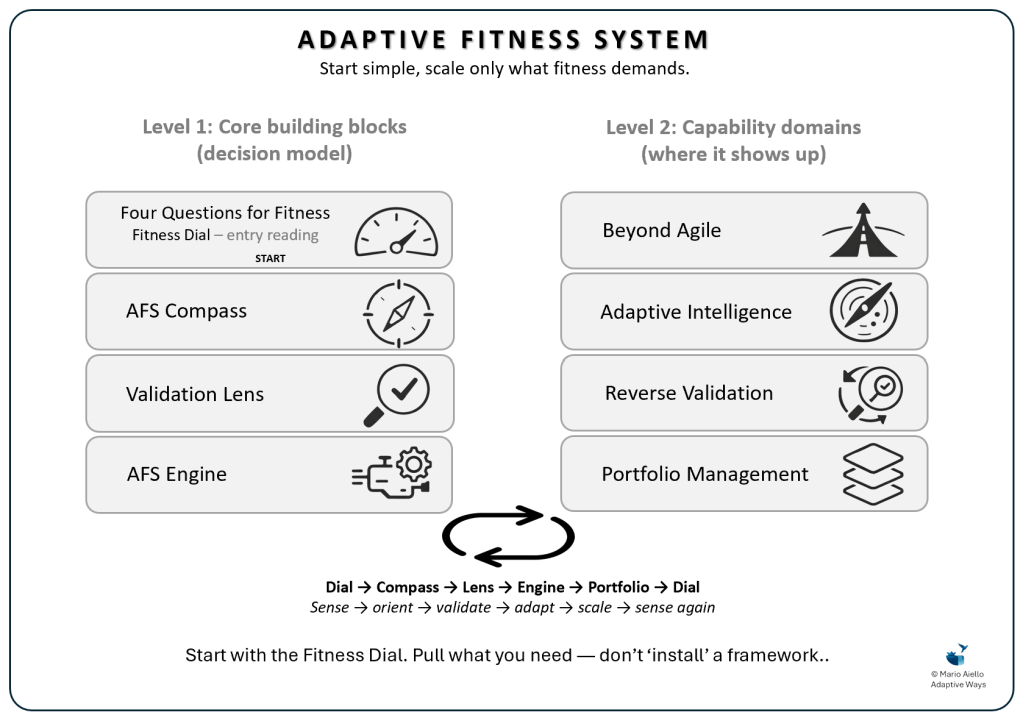
AFS works as a continuous sensing and adaptation cycle rather than a fixed implementation model.
Most organisations begin with the Fitness Dial and draw on the other elements as needed, scaling only what strengthens their capacity to adapt.
Start with the Dial. Pull what you need. Scale only what fitness demands.
The Fitness Dial
The Dial makes the system’s current state visible.
It helps leaders and teams sense where tension is building — whether around purpose clarity, contextual alignment, execution reality, or learning capacity.
Rather than diagnosing from distance, the Dial encourages continuous sensing of organisational health.
The Compass
The Compass helps orient decisions.
It translates the four fitness questions into a navigation tool, helping leaders choose directions that strengthen the system rather than fragment it.
Where the Dial shows where we are, the Compass helps explore where we might move.
The Validation Lens
The Lens tests whether proposed actions are viable in the real environment.
It encourages organisations to validate assumptions early — not only technically, but organisationally and culturally.
This helps reduce the gap between designed change and lived reality.
The Adaptive Engine
The Engine focuses on movement.
It helps organisations translate insight into action by reinforcing feedback loops, learning rhythms, and leadership signals that keep adaptation alive.
The Engine turns understanding into sustained motion.
The Portfolio View
The Portfolio ensures change is governed at system level rather than initiative level.
It helps organisations see how multiple efforts interact, compete for attention, or reinforce each other.
This prevents local optimisation from undermining overall organisational fitness.
The cycle in motion
AFS is structured as a continuous cycle rather than a fixed implementation model.
The Dial senses.
The Compass orients.
The Lens validates.
The Engine moves.
The Portfolio aligns.
Then the cycle repeats — helping organizations adapt without losing coherence.
Explore the Foundations of AFS
If you’re new to AFS, start with these pages:
- Four Questions for Fitness → How to diagnose readiness for change
- From Questions to System → How those questions become an operating model
- Fitness Requires Honesty → What keeps the system alive over time
Understanding the Adaptive Fitness System is less about adopting a model and more about changing how you look at organizational change.
You might use AFS to:
- reflect on why a current initiative feels stuck
- test whether a proposed solution fits your context
- structure conversations about adoption and alignment
- make trade-offs more explicit at leadership level
- or simply sense where organizational friction is building
There is no single way to apply it.
Most organisations begin with one question, one tension, or one initiative — and use the system to explore what strengthens or weakens their ability to adapt.
If you’d like to explore further, you might:
👉 Follow the ongoing reflections on SubStack
👉 Download the AFS overview for a concise reference
Adaptive Ways is an evolving exploration.
If something here resonates with your experience, you’re welcome to continue the journey.
 Adaptive Ways