
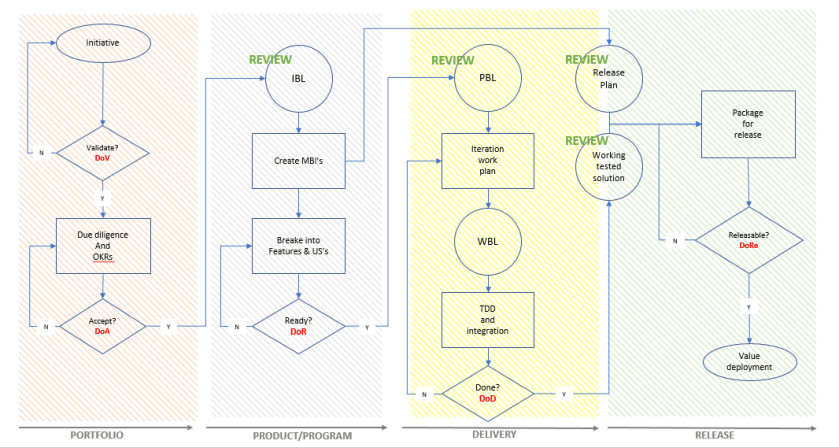
Business as well as technical initiatives flow through the value streams and the respective workflows in order to generate value outcomes.
Business initiatives are what drive the organization in respponse to client and market needs. Technical initiatives keep the organization technical platform up to date in order to motor the business. Initiatives need to be validated by a Definition of Valid (DoV)
Appropriate due dilligence is applied to viable initiatives and OKR’s set to track the progress alignment. This process, guided by the portfolio workflow and owned by the portfolio team, produces output that is reviewed and accepted against a Definition of Acceptance (DoA). The portfolio process outcome is the Initiatives Backlog (IBL).
The IBL feeds the Product Management process, whose workflow and team, will create the Minimum Buisiness Increments (MBI) and the appropriate release plan. MBI’s are then broken up into workable features and work items (both user and job stories) that are governed by a Definition of Ready (DoR); then reviewed and accepted as the process outcome: the Product Backlog (PBL)
The PBL will then guide the delivery teams in their quest for quality value (small batch work driven by tests) through iterative planning and execution, and governed by the Definition of Done (DoD). Working tested solutions are reviewed and accepted and released according to plan.
MBI’s that are ready for packaging and release are checked against a Definition of Releasable (DoRe) by the release management workflow and team, to ensure value deployment.
Through team’s ownership, transparency and feedback, quality is built iteratively into the value flow in order to guarantee that the organization is working on the right things, doing it in a right manner, and in a repetitive way to delight customers.

 Adaptive Ways