
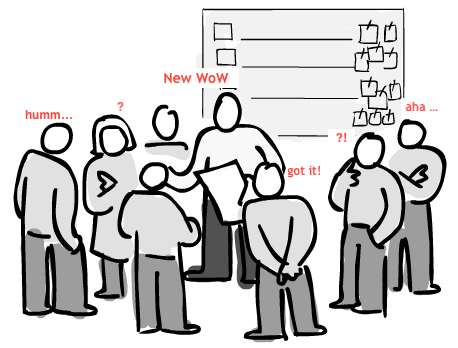
If I was asked to simplify agility concepts to make sure absolute beginners (including detractors) could buy into the organization’s new ways of working, I would first avoid using the word agile (and lean too).
A new WoW needs to be fit fpr purpose, fit for context, and fit for practice. Therefore if we can aproach our new audience explaining and debating these three dimentions of an agile transformation we can gather the necessary feedback to identify the existing constraints.
So we propose
How about if the reasons for the new WoW (the purpose) would be to achieve maximum productivity with minimum wasted effort while being successful in producing a desired result, and behaving in an expected way while adjusting to changing conditions.
How about if the circumstances (the context) for new WoW would be guided by principles such as simplicity, priority, owhership, cooperation, continuous value delivery, communication loops, and continuous improvement. And if customer satisfaction be acheived by relevant value streams, managing the flow of work, allowing teams to take on work according to capacity as they seek perfection in continuous improvement.
How about if teams were asked (the practices) to cut work into smallest possible value, to work on the most important thing first, to finish started work before taking on new work, to seek/provide help from/to othet team members, to deliver value on a regular basis, to seek/provide feedback as often as possible, and to adapt their work processes iteratively.
These concepts exposed in simple language will generate conversations and will enable the identification and understanding of the constraints that either compromise or slow down the transformation efforts.
An agile transformation requires a transition to new ways of working followed by an evolution towards business agility. Popularising agility concepts is the first step towards business agility.

 Adaptive Ways