

The latest years as agility consultant and coach I came across some other particular cases which I have approached through the same lens as the cases in my previous post of The Good, The Bad, and The Ugly.
The purpose is to identify what is well done, what needs fixing and what should be eradicated (if possible)
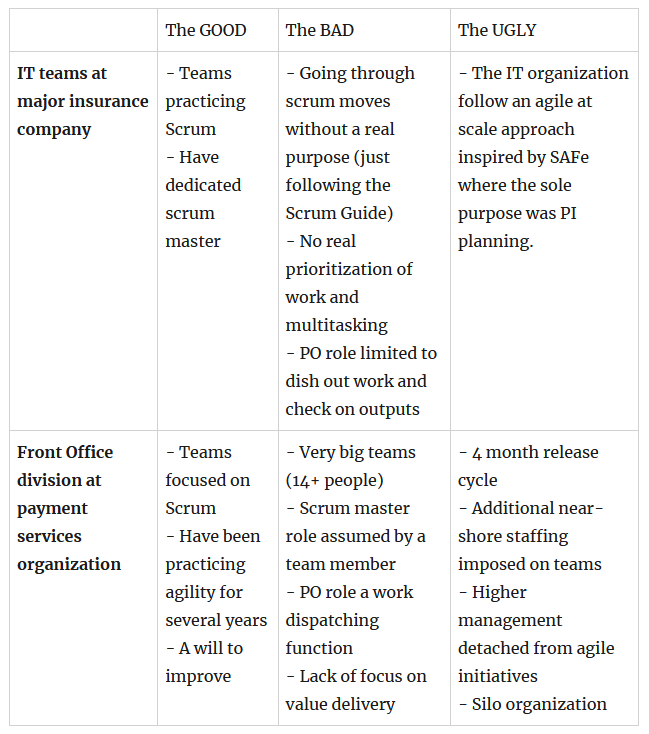
The table below depicts the findings at two major clients, and the actions taken are described in the following paragraphs:
Actions taken
At major insurance company – Revisited the Scrum guide and found the purpose of Scrum roles, events, and artifacts.
Injected to the Scrum practices the concept of working on one thing at a time, most important first, and finishing it.
Priority way defined through sizing work and the impact of delay.
The most senior developer assisted the PO with PBL refinement and clarification towards the team.
A definition of ready and definition of done were defined in order to guide work acceptance and completion.
At payment services organization – Decoupled the big teams by creating dynamic focused teams around specific value creation. These teams form spontaneously at Sprint planning and disintegrate at sprint after the Sprint Review. They organize again the following sprint around the value focus objectives of the sprint goal.
Reduced the duration of daily standup focusing on created value and potential impediments as well as promoting instant improvements.
Established a work intake process to provide more efficient planning. Replaced story point estimation by work item sizing and velocity focus was diluted into completed work count.
PO’s were encouraged to break down Release goals into sprint goals and dynamic team purpose, paying particular attention to prioritizing and sequencing work based on cost of delay.
Dependency management was defined as a primary activity starting at the creation of the PBL, consolidating the management approach during the refinement session, and handling the dependencies (eradication or management) during the Sprint.
Finally integrated flow management into the Scrum structure with a view to allowing certain people to work as service providers to the dynamic organized teams.

 Adaptive Ways