
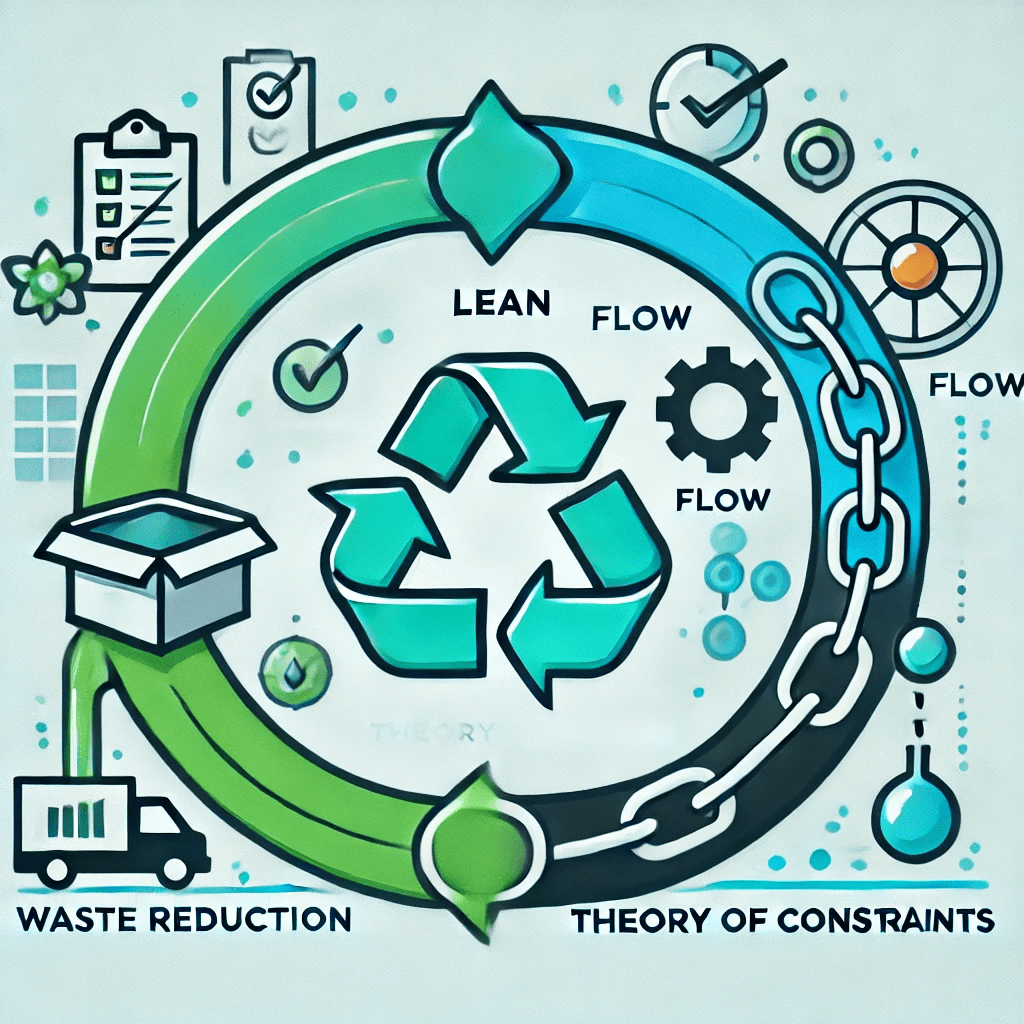
This approach is about leveraging ideas from methodologies originally developed for manufacturing applied to knowledge work: Lean is about efficiency, Flow is about optimisation, and Theory of Constraints about improvement.
Software development represents a prime example of complex knowledge work, where outputs are intangible, quality is multidimensional, and value creation is heavily dependent on cognitive processes. Software development thought process, researcher analysis, or a problem-solving approach cannot be directly observed or measured like physical production processes. This invisibility creates unique challenges in applying manufacturing-derived methodologies, requiring thoughtful adaptation rather than direct application.
Lean, flow and ToC are methodologies increasingly adapted for knowledge work settings. This transition, while challenging, has yielded valuable insights into improving knowledge work productivity and quality.
Lean thinking, with its focus on eliminating waste and maximizing value, remains remarkably relevant in knowledge work settings. However, the nature of “waste” differs significantly, for example, context switching, information wait states, and over-processing
Flow in knowledge work focuses on creating smooth, uninterrupted progress of value creation through the system, including, work item size, work in progress (WIP) limits, and visualization
Theory of Constraints core insight – that systems are limited by their constraints – applies powerfully to knowledge work, though identifying constraints can be more challenging, such as, cognitive bandwidth, bottleneck resources, and environmental constraints.
Successfully applying these methodologies in knowledge work requires (i) adaptive implementation of these concepts to specific context while maintaining the core principles, (ii) measurement evolution through new metrics that meaningfully capture knowledge work productivity and quality, moving beyond simple output measures to value-based metrics, (iii) cultural shift that values flow, continuous improvement, and systematic thinking about constraints and waste.
—-
Note: This post is inspired by an approach by Al Shalloway (Success Engineering) that I found useful to design a solution for a delivery organisation I’m currently associated with.

 Adaptive Ways