
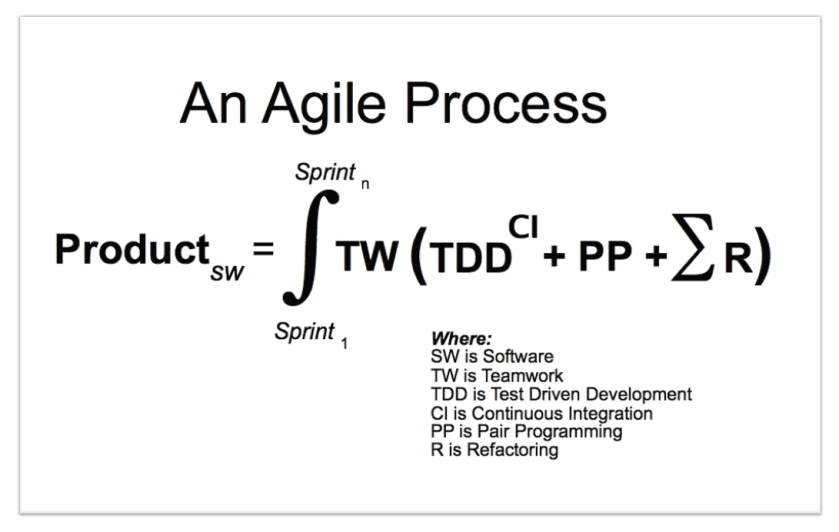
In most agile implementations I’ve been involved with, the following sequence is the most evident one “chose methodology – train/follow by the book – check for agility”, a typical push approach by which it is quite difficult to make sense as it is not necessarily suited to the organization’s operational reality.
On the other hand, if organizations were to follow “understand agility – map it to current ways of working – chose/create a method for new ways of working”, the transition would be easier (through a pull approach) as we attend to the issues related to the gaps encountered.
The concept of simple agility came to mind when trying to explain agile to several Scrum teams that struggled to make sense out of the new way of working: Scrum was the chosen path to agility, everybody got Scrum education, practiced scrum by metrics, few managed to understand agility.
I explained agility to teams in three steps (workshops):
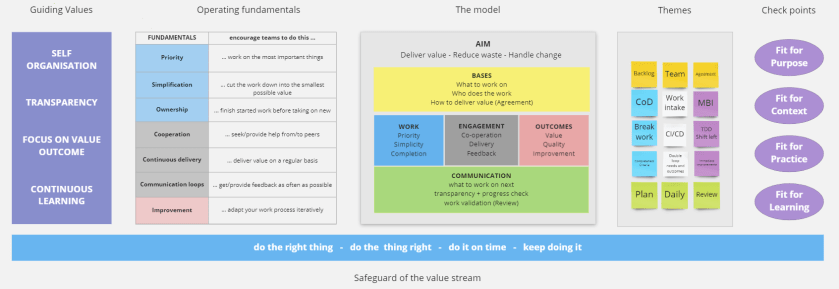
- operating fundamentals, and the underlying values, to guide how work is processed
- workflow components, and themes that support it
- checkpoints to align the new way of working, and safeguard of the value stream
Using everyday language, no agile jargon nor buzzwords, and keeping it as simple as possible, resulted in an efficient way to understand concepts and achieve consensus.
Therefore, the purpose of simple agility is to help understand the new agile way of work, then facilitate the choice of an agile method to drive the transition.
We started with a workshop to illustrate and apply the fundamentals (priority, simplification, ownership, cooperation, continuous delivery, communication, and improvement). The team took current work items and was asked to work on the most important thing after decoupling the work into the smallest possible value. Then they were asked to finish the work engaged before starting new work, and if necessary, seek or provide help. This would encourage delivering finished work regularly and receiving immediate feedback which in turn highlight the necessary improvements to the flow of work.
So far, all what was asked from the team are common everyday activities, easy to understand and justifiable in their own right. Suddenly, the team was working in a new way looking to optimize their time, doing only what was necessary, and coping with variations the best they possible could.
The underlying values were then more evident and easier to grasp, as the team was practicing self-organization and being transparent, focusing on delivering value and learning from it.
The next step (workshop) came naturally as the team was looking to how to organize their work. The agreement upon what the team was aiming for was evident as this would trace the road on which the team would travel: what value are we delivering next.
Then the bases for work were set by picking the items to work on next and making sure all (or at least most) of the necessary skills to complete the work were available. All this glued together by a set of agreements on how work will be carried out to completion.
The workflow (work, engagement, and expected outcomes) is thus guided by the fundamentals previously discussed and supported by a series of themes aligned around responsibilities, for example:
- Work is prioritized based on cost of delay
- Work is broken down to its smallest (sense making) possible value
- A definition of done is agreed upon
- A work intake process is implemented
- Continuous integration and delivery defined
- Use the dual loop principle for feedback
- Value delivery through what makes business sense
- Quality maintained through a shift left approach to testing
- Immediate improvements to daily work
Communication, being the fuel for the team’s progress down the value delivery road, happens almost naturally when the team finishes a set of work and decides what to work on next (work planning); have a cadenced alignment session to check cohesion towards value delivery goals (daily progress); and verify the completed work against a definition of done (work review).
The final workshop was focused around providing answers to a set of questions allowing the teams to see the coherence of their new way of working:
- Is the new WoW in line with what we want to achieve? (fit for our purpose)
- Is the new WoW suited to our reality and circumstances? (fit for our context)
- Is the new WoW easy to carry out? (fit for practice)
- Does the new WoW allow for inspect and adapt? (fit for learning)
and to check alignment of the value stream they belong to:
- Are we working on the right thing? Check our effectiveness – successful in producing a desired result
- Are we doing it right? Check our efficiency – achieving maximum productivity with minimum wasted effort
- Are we able to do it on time? Check our predictability – behaving in an expected way
- Can we keep on doing it? Check our adaptability – adjusting to new conditions
Conclusion
Simple agility is based on the understanding of some basic fundamentals and easing these into the team/organization ways of working. Making sense out of these fundamentals is the key to durable agility.
Simple agility is all about owning the work and making it transparent; committing and collaborating to finish work; and delivering value in a continuous manner. It is all about pursuing and achieving TRUST in yourself, the team, the governance.
The aim is to produce value frequently, while working closely with the value consumers, and adjusting work continually based on current knowledge.

 Adaptive Ways