

The work intake or acceptance system refers to a well-defined method by which the work is taken over by the technology. It is the bridge between the group of stakeholders defining what to work on and the technology group that will build it.
This intake process has two parts:
- the discovery process, where stakeholders decide what they want to work on,
- the development process, where the development organization builds on the work defined in the discovery process.
The backlog is the connection between the two processes, the end point of business/product responsibilities, and the starting point of the creation/delivery process.
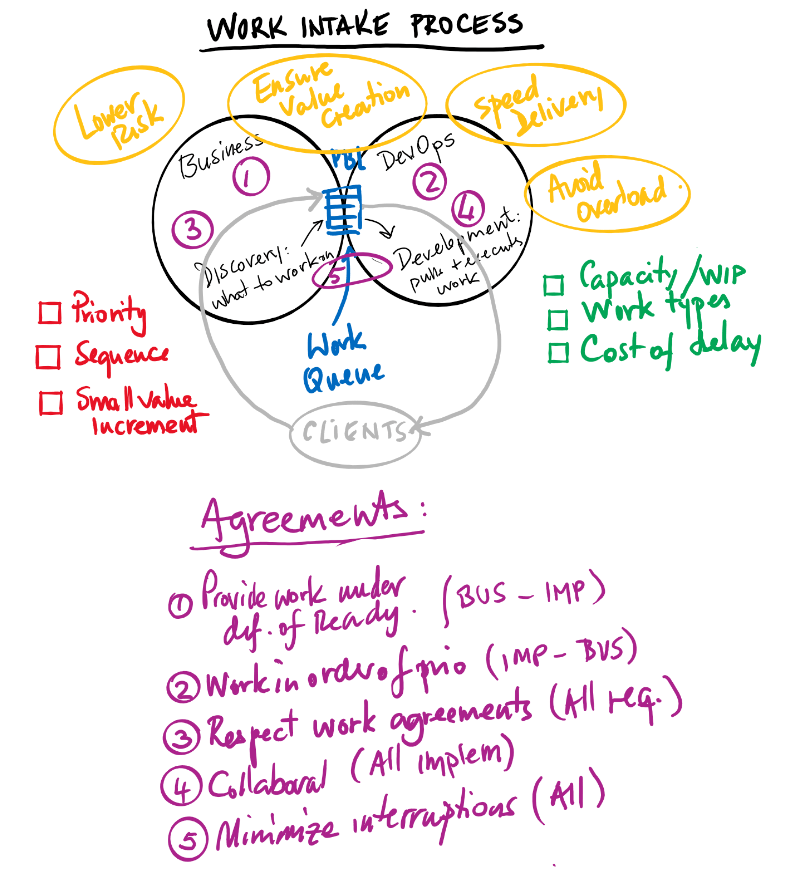
Intent of the Intake System
In general, teams that work on too many things at once decrease their productivity, and the goal of a work intake system is to allow people to start working when they are ready. Overloading people leads to multitasking, creates extra work, and tends to burn people out.
The impact of the intake system on business stakeholders
A good intake system limits the amount of work given to technology teams to the maximum amount they can handle effectively. It highlights the fact that adding more work than they should be given slows everything down. This is often a reality check for business stakeholders. By realizing this reality, they can learn that what they give to technology needs to be focused on value that can be realized more quickly. They have a responsibility to do this and cannot simply hand the work over to technology to do.
Therefore, the use of minimum units of value is so important in the intake process. All elements should be as small as possible while still providing value to the organization when completed. The definition of these elements is the responsibility of the stakeholders in the organization.
The impact of the intake process on technology
A well-defined and efficient intake system has a beneficial impact regardless of the approach used. Avoiding overloading work teams not only greatly reduces the turbulence and chaos that would otherwise result, but also reduces the challenge of coordinating teams.
Controlling the intake process is critical. Even if business stakeholders are not doing their jobs as well as they should, technology can put a blocking factor in place if needed. It’s interesting to note how all effective approaches handle this:
- Scrum: extract the equivalent of a sprint’s worth of work from the product backlog and let no other work in.
- SAFe: extract the equivalent of one program increment from the product backlog.
- Kanban: use a flow model and only pull work when you can do so.
Managing the acceptance of different types of work
Intake systems often need to manage different types of work, each of which is very different in size. There are three things to consider when accepting work:
- An understanding of the demanded work and that it is complete according to the agreed acceptance standards (Definition of Ready)
- The work capacity of the team and the optimal amount of work in progress
- Consideration of the cost of delay (what it costs an organization in terms of lost revenue, opportunities, increased risk, customer respect, etc., due to a delay in realizing value).
Keys to an Effective Admissions Process
Important factors for an effective system are:
- All work must flow through the intake system.
- The work in the intake process is sequenced so that when it is pulled out, downstream people can see what they need to deal with conflicting demands (they look at the sequence in the intake process).
- They have agreements about the use of the intake system, which is the focal point of the organization’s alignment.
Conclusion
Introducing an intake system for business and other stakeholder work requests is a strong complement to any workflow improvement initiative in the value chain.
It allows stakeholders to understand why they need to focus on the initiatives, and work increments that will bring the most value. It can be used to explain to why focusing on them reduces risk, accelerates delivery, and helps ensure value creation. At the same time, it protects the technology from overload.

 Adaptive Ways